In stock
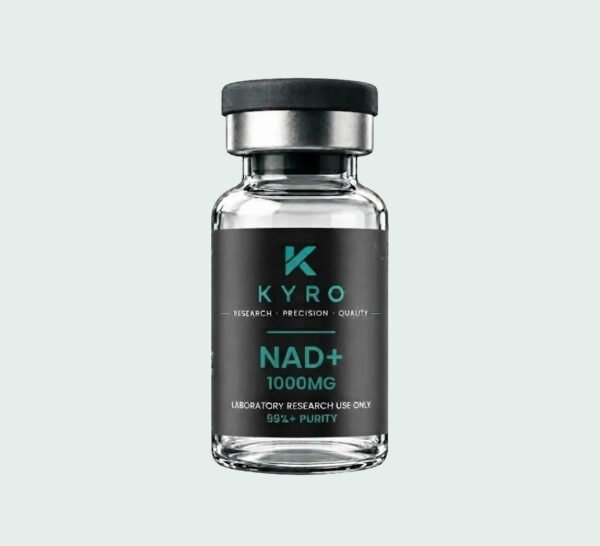
NAD+ (nicotinamide adenine dinucleotide) is a coenzyme studied in research into cellular-energy metabolism and sirtuin-pathway signalling in experimental models.
NAD+ (nicotinamide adenine dinucleotide) is a coenzyme present in all living cells, formed from a nicotinamide nucleotide and an adenine nucleotide. It carries electrons in redox reactions, cycling between NAD+ and its reduced form NADH. Formula C21H27N7O14P2, molar mass 663.4 g/mol. Kyrolabs supplies it for research use only.
NAD stands for nicotinamide adenine dinucleotide. The plus sign in NAD+ denotes the oxidised form, which carries a net positive charge on its nicotinamide ring; NADH is the reduced form. Both are studied as coenzymes in cellular biochemistry.
Note a naming clash: in a clinical chart, NAD is usually an abbreviation for 'No Abnormality Detected' (or, historically, 'nothing abnormal detected') and is unrelated to this compound. The NAD+ supplied here is the coenzyme nicotinamide adenine dinucleotide (CAS 53-84-9), a defined research chemical, not a clinical-charting term.
No. NAD+ is a dinucleotide coenzyme, while NMN (nicotinamide mononucleotide) is a precursor molecule that sits upstream of NAD+ in biosynthetic pathways. They are distinct compounds with different identifiers. NAD+ alone carries CAS 53-84-9 and PubChem CID 5892.
No. Peptides are short chains of amino acids; NAD+ is a dinucleotide coenzyme. It is supplied here as a defined research chemical, characterised against its published molecular identifiers rather than as a peptide sequence.
In research, and in laboratory models, NAD+ is studied as a coenzyme in redox reactions and cellular energy metabolism, and as a substrate for enzyme families such as sirtuins and PARPs. This describes its biochemical role in laboratory models and is not a claim of any effect in humans.
NADH is the reduced form of NAD+. The two interconvert as electrons are accepted and donated during redox reactions, forming a coenzyme couple central to cellular biochemistry. Research using NAD+ frequently references this NAD+/NADH cycling.
Studies examine NAD+ as a coenzyme in cellular energy metabolism and redox balance, its role as an enzyme substrate for families such as sirtuins and PARPs, and how its availability changes in cell and animal models, including a decline with age that drives interest in longevity research. None of this establishes an outcome in humans. The detailed evidence review is in our blog monograph.
As with any laboratory reagent, NAD+ should be handled using standard laboratory safety practice and the supplied Safety Data Sheet and Certificate of Analysis. It can act as an irritant and is sensitive to heat and hydrolysis, so it should be kept dry and cold. This is research-chemical handling guidance, not a statement about effects in humans, for whom it is not intended.
NAD+ is an endogenous coenzyme and is not a controlled drug under the Misuse of Drugs Act 1971. It is supplied strictly for research use and cannot be sold for human consumption. The buyer is responsible for lawful use; see our research disclaimer.
No. Purity and identity vary between suppliers, so verification matters more than the label. Each Kyrolabs batch ships with a third-party Certificate of Analysis confirming a minimum of 99% purity by HPLC and matching the published identifiers, including CAS 53-84-9 and CID 5892.
As a lyophilised research chemical, NAD+ is best kept sealed, dry and cold, away from light and moisture, in line with the storage guidance on its Certificate of Analysis. NAD+ is sensitive to heat and hydrolysis, so handling conditions affect the stability of the reference material.
Related
There are no reviews yet. Be the first to leave one.